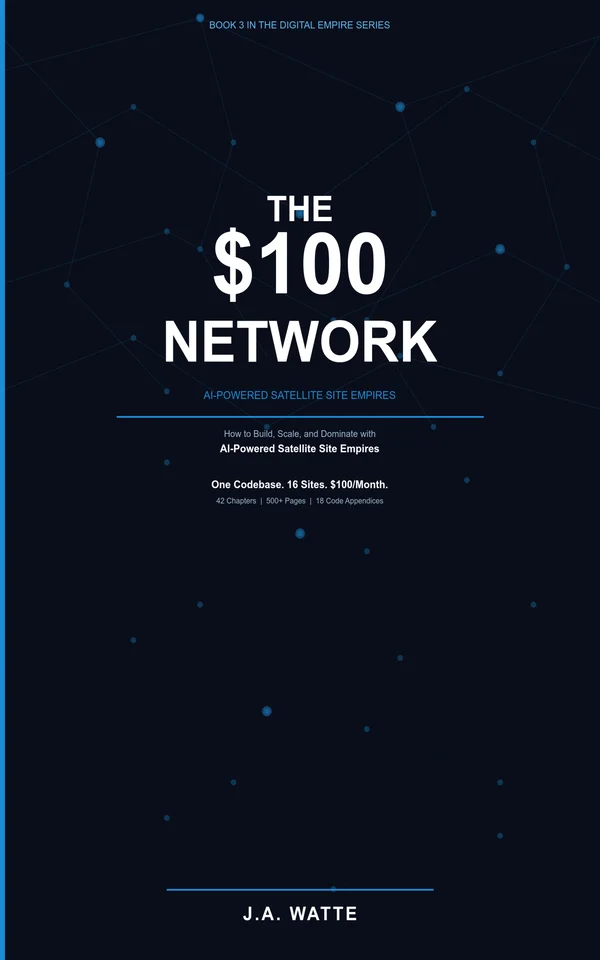
The $100 Network.
Stop pouring money into a single domain and hoping it ranks. This 500-page blueprint shows you how to build a network of 16 revenue-generating websites from one codebase, deploy them across free-tier hosting, fill them with AI-generated content at three cents per article, and get every page indexed within hours — all for less than what most people spend on a single SaaS tool.
For existing site operators, indie publishers, and niche-network builders ready to scale from one site to a 6-to-16-site portfolio.
You Built One Site. It's Working. But You've Hit the Ceiling.
You did everything right. You picked a niche, built a clean site, wrote solid content, and started getting organic traffic. Maybe you're earning affiliate commissions or selling a digital product. But now you're stuck.
One domain means one set of rankings. One Google algorithm update can wipe out months of work. One competitor with a stronger backlink profile can push you off page one overnight. You're paying $40/month for an SEO tool, $29/month for an email platform, $20/month for hosting, and another $15/month for analytics — and all of it protects a single point of failure.
The math doesn't change no matter how hard you optimize. A single site has a traffic ceiling, a revenue ceiling, and a risk floor that never drops to zero. The people earning six figures from content sites aren't running one site. They're running networks.
The Monoclone Architecture
The monoclone architecture is a single repository that generates 16 visually distinct, independently branded websites. Each site gets its own domain, color palette, typography, layout variations, and content — but they all share the same build pipeline, deployment scripts, and operational tooling. Change a template once, and every site in the network updates on the next deploy.
A single sites.json configuration file controls everything: domains, niches, monetization models, content targets, and provider assignments. One build command reads that file and outputs 16 production-ready sites, each deployed to free-tier hosting across Cloudflare Pages, Netlify, and Vercel. No server management. No DevOps team. No monthly infrastructure bill over $100.
What You'll Build
Monoclone Architecture.
The monoclone architecture from Chapter 2 lets a single repository generate 16 unique websites. Each site gets its own brand identity, domain, color palette, typography, and content — but they all share one build pipeline, one deploy script, and one sites.json configuration. Update a template once and deploy it across every site in the network in under a minute, without duplicating engineering effort.
$100/Month Infrastructure.
Chapter 10 breaks the network budget down dollar-by-dollar. Domain registration runs $8-12 per domain per year across Cloudflare Registrar and Namecheap. Hosting is free-tier across Cloudflare Pages, Netlify, and Vercel. The only paid API is AI content generation at ~$5-10/month. Total infrastructure for 16 live sites lands under $100/month — and a 2-3 site starter network runs under $30/month while you learn the system.
AI Content Factory.
The AI content factory in Chapter 11 generates publication-ready 1,500-word articles for approximately $0.03 each at Claude Haiku or GPT-4o mini API pricing. The pipeline chains structured prompts, automated quality scoring, hallucination flagging, editorial review gates, and scheduled publishing — enough to output 50+ articles per week across a 16-site network while keeping a human in the loop for the final edit.
Three-Protocol Indexing.
The three-protocol indexing stack in Chapter 18 submits new pages to Google, Bing, Yandex, Seznam, and Naver within minutes of deployment. The pipeline fires IndexNow API POSTs, Google Indexing API requests, and traditional sitemap pings in parallel — all wired into your Netlify or Cloudflare Pages CI/CD build so every deploy ships with fresh submissions across all search engines automatically.
Edge SEO with Cloudflare Workers.
Chapter 23 ships 12 production-ready Cloudflare Worker recipes for edge SEO: inject FAQPage and Product schema markup at the edge, rewrite meta tags and security headers, A/B test titles, manage redirects, and manipulate response bodies — all without rebuilding or touching your static site generator. The edge stack runs on Cloudflare's free Workers tier (100K requests/day) and deploys via Wrangler CLI.
Build, Don't Subscribe.
The Build-Don't-Subscribe chapters replace roughly $560/month in SaaS subscriptions — Ahrefs, Semrush, Surfer, Frase, ContentKing, and rank trackers — with tools you build yourself using Claude Code or the prompt-plus-weekend test. Rank tracking, content scoring, internal link analysis, monitoring dashboards, and competitor audits all run on code you own and control across the 16-site network.
Before vs. After This Book
| Category | Before | After |
|---|---|---|
| Sites | 1 domain, single point of failure | 16 independent sites, diversified risk |
| Monthly Cost | $560/month in SaaS tools | $100/month total for the entire network |
| SEO | Manual submissions, waiting weeks for indexing | Automated three-protocol indexing in minutes |
| Content | $50-200 per article from freelancers | $0.03 per article with AI content factory |
| Deployment | Manual FTP or single-provider lock-in | One command deploys to three providers |
| Monitoring | Checking each site manually | Centralized dashboard for all 16 sites |
| Revenue Ceiling | Capped by one domain's traffic | 16 independent revenue streams |
From the Blog
Satellite Sites vs PBNs — The Difference.
Why a portfolio of real branded sites is not a private blog network. How Red Ventures, Wirecutter, and NerdWallet prove the model at scale.
Read article →.SaaS Tools AI Can Replace in a Weekend.
The prompt-plus-weekend test for every subscription. Which SaaS tools you can build yourself and which have genuine moats worth paying for.
Read article →.Edge SEO with Cloudflare Workers.
Dynamic schema injection, hreflang from one codebase, A/B testing titles, and redirect management — all at the CDN edge for free.
Read article →.Part of the Digital Empire Series

The $97 Launch.
Start from nothing. Pick a niche, validate your idea, build a site, create a product, and make your first sale — all for under $97 in total startup costs.
Learn More about The $97 Launch.
The $20 Agency.
Fire your marketing agency. Use AI tools to handle copywriting, SEO audits, social media, email campaigns, and analytics for $20/month instead of $1,000.
Learn More about The $20 Agency.
The $100 Network.
Scale to 16 sites, automate content with AI, and build the infrastructure to dominate multiple niches — all for $100/month.
Get the Book.Also by J.A. Watte: The Trap Series

The W-2 Trap.
The W-2 Trap maps why an employee salary is a ceiling, not a floor, across 541 pages and 80+ exit strategies. Covers currency devaluation, tax asymmetry, LLC/S-Corp entity structures, veteran benefits, blue-collar and skilled-trades paths, AI displacement timelines, and income-tier playbooks from $0 to $450K+ — the diagnosis book in the Trap Series for readers who want to replace W-2 income with owner income.
Learn More about The W-2 Trap.
The Resale Trap.
The Resale Trap runs the full 25-year total cost of ownership on single-family homes and proves that a $400K resale home costs $318K–$506K more than a comparable $400K new build. 395 pages, 22 chapters, all 50 states ranked on an 8-dimension composite score (property tax, insurance cost, construction cost per SF, land availability, water quality, hazard exposure, regulatory environment). Every claim sourced to NAHB, RS Means, FHFA, Harvard JCHS, and NAIC.
Learn More about The Resale Trap.
The Condo Trap.
The Condo Trap quantifies the seven financial forces draining condo equity across America — HOA fees, special assessments, Energize Denver / Local Law 97 / BERDO energy mandates, Colorado metro-district taxes adding 50-80 mills, insurance crisis, pension-driven property taxes, and environmental risk. 380 pages, introduces the Property Investability Score, and proves a mortgage-free Denver condo still costs $1,900/month to carry — a 233% jump from 2006.
Learn More about The Condo Trap.See how every site in your network stacks up.
🔭 Mega Analyzer — one URL, seven dimensions, 0–100 score.
Ranking / Hygiene / AEO / Performance / Security / Trust / Compliance in a single pass. Every finding deep-links into a specialist tool plus an AI fix prompt for ChatGPT, Claude, or Gemini. Running a multi-site portfolio? Mega Batch runs the same scoring across up to 20 sites side-by-side. No signup. No stored data. Free.
Scored below 80? Here are the resources to fix it yourself.
Every failing Mega Analyzer check maps to a specific chapter in the Trap Series. The analyzer tells you what's wrong. The books show you exactly how to fix it — with code, templates, and step-by-step instructions. For single-URL SEO-only audits, the Site Analyzer is the narrower companion.
Frequently Asked Questions
What is the monoclone architecture?
The monoclone architecture is a system where a single code repository generates multiple visually distinct websites. Each site gets its own domain, branding, color palette, typography, and content — but they all share the same templates, build scripts, and deployment pipeline. A central configuration file called sites.json defines the unique properties of each site, and one build command produces all 16 production-ready outputs.
Do I need to know how to code?
You need basic comfort with a terminal and a text editor, but you don't need to be a software developer. The book provides complete, copy-paste-ready scripts for every major task — build scripts, deployment automation, content generation pipelines, and monitoring dashboards. If you can edit a JSON file and run a command like npm run build, you have enough technical skill to follow along. Chapter 2 includes a prerequisites checklist with free resources to fill any gaps.
How much does the infrastructure actually cost?
The book includes a detailed month-by-month budget planner in Chapter 10. The largest recurring cost is domain registration, which runs $8-12 per domain per year. Hosting is free-tier across Cloudflare Pages, Netlify, and Vercel. The only paid API is for AI content generation, which costs approximately $5-10/month depending on volume. Total infrastructure for 16 live sites comes in under $100/month, and you can start with just 2-3 sites for under $30/month while you learn the system.
Is this a private blog network (PBN)?
No. A PBN exists solely to pass link equity to a money site and typically features thin, low-quality content on expired domains. The $100 Network is a collection of legitimate, content-rich websites that each serve real audiences in their respective niches. Each site is independently valuable, carries original content, and can be monetized on its own. Chapter 25 covers in detail how to keep sites operationally separate and avoid any footprint patterns that search engines associate with manipulative networks.
What makes this different from other SEO books?
Most SEO books teach you how to optimize one website. This book teaches you how to build and operate an entire network of sites as a system. It covers infrastructure engineering, automated deployment, AI content generation, edge computing, programmatic SEO, and network operations — topics you won't find in a typical SEO guide. Every chapter includes working code, not theory. The 18 appendices alone contain more usable scripts than most technical courses.
Can I really generate articles for $0.03 each?
Yes, with caveats. The $0.03 figure is based on using Claude or GPT-4 API pricing for a structured 1,500-word article using the prompt engineering system described in Chapter 11. The cost comes from API token usage, not a subscription. Quality depends heavily on your prompts, your quality gates, and human review. The book teaches a pipeline that includes automated scoring, fact-checking prompts, and editorial review — the AI generates the draft, but you control the quality bar before anything goes live.
Common Questions
What is the monoclone architecture?
A monoclone is one codebase that generates many distinct-looking websites. Each site has its own domain, brand, content, and deployment, but they all build from the same source tree via per-site configuration (sites.json). The book walks through defeating template fingerprinting so the sites look unrelated to search engines — different structures, different word patterns, different assets — while sharing the engineering effort across all of them. It's the operational opposite of WordPress Multisite, which shares one database and one admin for many subdomains.
Why 16 sites, not 50 or 100?
Sixteen is the sweet spot for a solo operator running the network at $100 per month. It fits within Netlify / Vercel / Cloudflare free-tier limits (100 GB bandwidth per site, 300 build minutes), each site gets enough content velocity to actually rank (not a ghost town), and you can still write or supervise the AI-generated content for each niche without losing track. Going to 50+ sites requires an infrastructure upgrade — paid tiers, CDN worker budgets, a content review pipeline — which is covered in the advanced chapters but not the baseline blueprint.
What does “AI content at three cents per article” actually mean?
At current API pricing (Claude Haiku or GPT-4o mini), a 1,500-word article with structured prompts, quality gates, and an edit pass costs roughly $0.03 in model inference. The figure includes the prompt tokens, the output tokens, and a small supervisor pass to flag hallucinated facts. It does NOT include your time, the editorial review every piece still needs, or the cost of the fact-checking tools. Chapter 11 details the full content factory from prompt engineering through scheduled publishing and how to budget for a network producing 50+ articles per week.
Is this a private blog network (PBN)?
No. A PBN is a network of sites that exist primarily to link to a money site — typically low-quality, low-traffic, and a Google penalty magnet. The $100 Network architecture builds legitimate niche sites that serve real users and have their own monetization (affiliate revenue, display ads, info products, email lists). Chapter 20 covers cross-domain linking patterns that stay on the right side of the line — internal promotion between sibling sites without manipulative anchor-text schemes. If your plan is to spin up shell sites and funnel link equity, this book is not for you.
Do I need coding skills to follow the book?
You need to be comfortable editing a JSON configuration file, running commands in a terminal, and understanding what a git commit does. You do NOT need to write JavaScript, CSS, or any production code from scratch — the book ships every script you need, and the AI-assisted development chapter walks through using Claude Code or OpenAI Codex to modify the scaffolding when you want to. If you've deployed anything to Netlify or Vercel once, you have the prerequisites. If you haven't, Chapter 1 covers the full onboarding from zero.
